Pages

Showing posts with label yeoor. Show all posts

Sunday, 11 March 2012

Wandering destination: Around Mumbai


Greater Flamingo at Shivadi


IIT Bombay campus hosts innumerable varieties of birds, flowers, trees and butterflies. However, it has natural and ecological limitations. Every living species around Mumbai cant be seen in the campus. Some of the species are jungle dwellers and prefers thick, unattended forest. For example some butterflies species like Baronet, Tinsel, Western centaur Oakblue are seen in the jungles of SGNP and Tungareshwar WLS but IITB Campus. To explore more wonders about nature, apart from campus, there are some immediate destinations near Mumbai sub-urban. Here is consolidated information about one-day return spots.

Lungs of Mumbai, SGNP
Sanjay Gandhi National Park (SGNP): Campus shares some of its boundaries with SGNP. SGNP, a  protected are of about 104 sq. km., spreads from Borivali to Thane.  An estimated 800 types of flowering plants; 284 kinds of birds; 5,000 species of insects; 36 types of mammals; 62 reptiles and 150 species of butterfly can be found. some distinguished features of the park are nature trails, Karvy flowers blooming after every 7/8 years, Kanheri caves. Ticket for individual is 20 Rs and park can be accessed from 6 AM to 6 PM. From IIT, BEST or NMMT buses drops you at the very entrance of the park. Private vehicles are allowed inside the park with some fees. For trekking and nature trails, prior permission is required.

Jungles in SGNP


Shiwadi bird watching spots
Shivadi: Famous for Flamingo's. Many other water birds (gulls, waders, snipers, herons,etc) can be seen in the mangrove forest. Best time of the day would be morning to visit. The are plenty of spots to seat calmly and watch bird activities. Take a train from Kanjur to Shiwadi, with one change over at Dadar. Start walking towards sea coast and ask for Jetty. Jetty is the best spot among many. Siwari fort could be an attraction for some, Colgate gate is another point to watch birds closely.  


Yeoor Hills: This is entry to SGNP from Thane. Buses from IIT Main gate to Mulund and then catching bus towards yeoor takes about 45 minutes to reach the destination under normal circumstances.


Tata power plant at backdrop, Shivadi

Map of Nagla Block
Nagla: Another extension of SGNP. Its far from the disturbances by the tourists. For butterfly lovers, there can be few surprises post monsoon season. Some exotic species of butterflies like Silver streak Blue, Chocolate Albatross, Orange Awlet, Acacia Blue are often sited. To reach Nagla, take a bus from Main gate to Mulund and then from Mulund to Hotel Fountain. Walk about a kilometer towards Ahmedabad on the highway and there u are. On right side there are some houses and thats the way in to the Nagla block.

Mahim Nature Park: Situated in the midst of city and spread over a large area on the banks of Mithi. Very well maintained and can be good starting point to watch nature closely and comprehensively. It hosts every natural element : birds, butterflies, flowers.Entry fee is 10 rs. Permission required to take photos. A bus from Gandhinagar bus stop drops very near to MNP.

Saturday, 10 March 2012

Angles for butterfly photography


Army of bluebottles puddling

Photography of a full grown butterfly can be divided into two categories : Documentary and Artistic. In this post I will be discussing both of them in details with some interesting examples. Many photographers hesitate to move, bend and sometimes laying on the ground. Simply taking the photograph from the angle you first see it, does not makes a great photo. As a thumb-rule, for every purpose of butterfly photography and butterfly activity, there exist a typical angle to shoot. However this rule doesn't apply for artistic photography.

A. Butterfly Documentary Photography:
Purpose of this kind is help for identification, spot record and documentation.


1. Closed wing / Under wing (UN) shot:  In case of some species like lascar, sailor this shot is of utmost importance in identification process. A perfect UN photo is needed to see all the marking on the wing neatly. To accomplish, this one has to wait for butterfly to close its wings and settlement. During nectoring, butterfly seats on the flower. If the flower is not high enough, one needs to to bend. Otherwise one has to adjust the height accordingly.

After this, photographer should get in a place where camera is exactly perpendicular to the wings of the butterfly. Such angle covers the whole wing. It also helps to have lower aperture number, as depth of field required would be very shallow. Lower f-number will help to choose higher shutter speeds (improves sharpness of the photograph) and lower depth of field will impart nice bokeh to the image. Both features will enhance the beauty of the photo and additionally will make a perfect picture for documentation. This position of camera/photographer is much important when shooting mud-puddling butterflies.

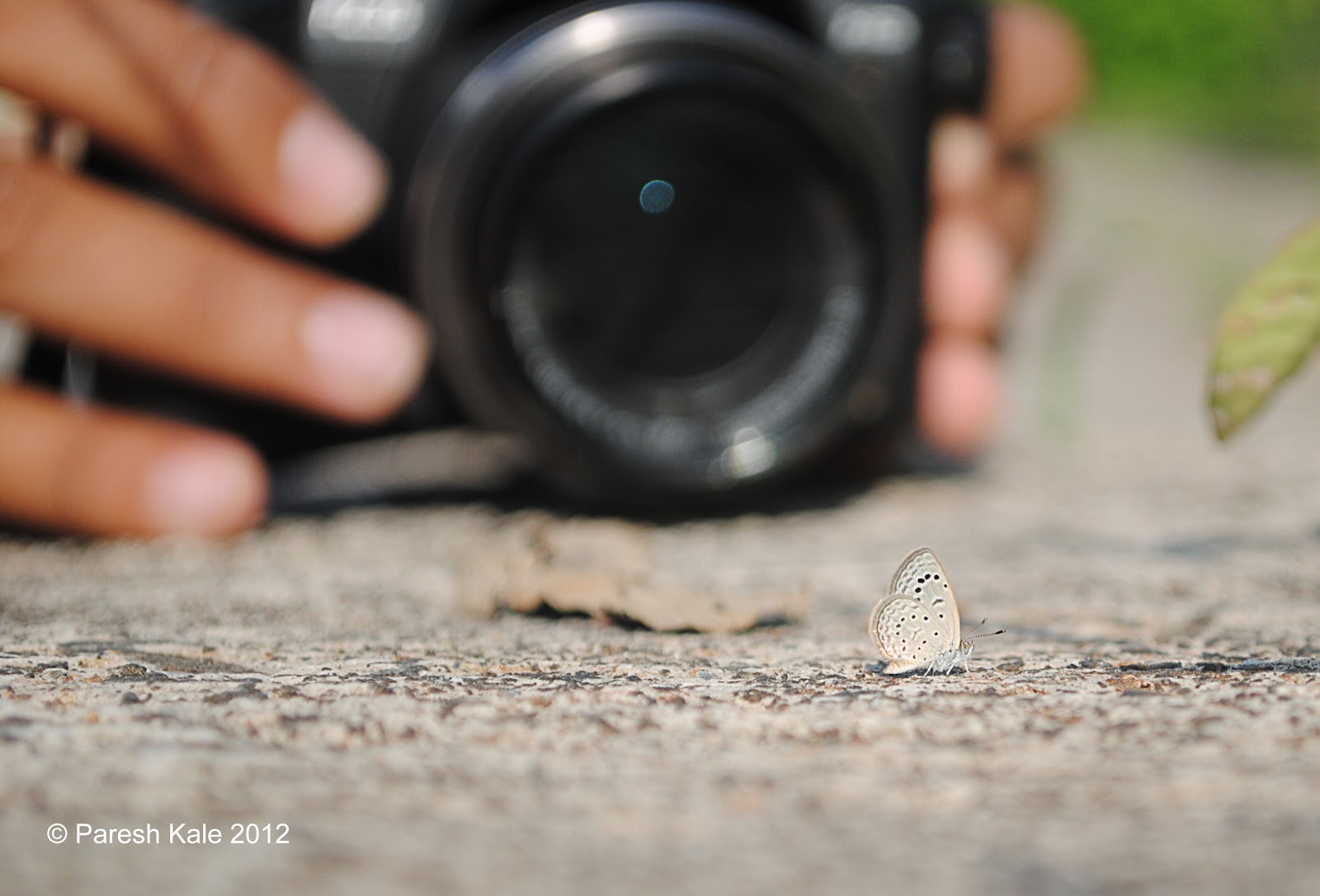
One has to lay down flat on the ground to shoot in this angle. Often, photographers keeps standing and shoot mud puddling butterfly. This gives a slant and partial view of the same. If one cant lay down on ground, camera with veri-angle screen e.g. Canon 30X, Canon 60D etc is useful. Veri-anlge LCD will help to keep camera on ground and then tilting the LCD to view, focus and compose the image. Another case for a closed wing would be when  butterfly is resting on some small object with wings complete open. This can also provide under wing shot, small object hiding some part of the body.


Use of veri-angle or tilting LCD for mud-puddling butterfly


2. Open wing / upper wing (UP) shot: Apart from help in ID, Open wing shot often helps in differentiating male and female. There can be two occasions to get complete open wing shot of a butterfly: While basking or while mud-puddling. In the morning, butterfly often seats on a large leaf with wings flat open. This is in order to dry there wet wings because of dew. Most butterflies seats at suitable height for photographing, specially the small ones like plains cupid, line blues, lime blue etc. Some like Tawney rajah seats on a big leaf at some height, not reachable, making ti difficult to photograph. Again for a perfect open wing shot one should bring lens axis perpendicular to the plane of the wings spread. Advantages are same as stated in closed wing shot.

Perfect angle of tiny butterflies is sometimes intriguing


3. Miscellaneous shots: On very rare occasions, shot of the antenna is required. The angle to shoot whole of the antenna would be perpendicular to the plane of the antenna. This is critical shot, as one must shoot it at 1:1 macro. 

B. Butterfly Artistic Photography: 
Shot this beauty from the front while mud-puddling
        Although, every perfect and sharp shot taken with documentary kind of angle will be artistically appreciable I wish to mention some angles in this category. My personal favorite is the front angle. Eyes of butterfly is a striking feature when shot closely. A complex-eye structure is fabulous when seen in close-up. When shot from front side of the butterfly, during nectoring or mud-puddling, both eyes are captured. Mud-puddling is the best opportunity to have such shot. Added advantage in this case is the proboscis inserted in the ground. Another angle would be from behind of the butterfly. Almost every butterfly has dummy eyes like markings on its hind-wings. This is to create an illusion and in order to protect butterflies from predators like bird. These eyes and sometimes tails can be interesting to watch.


Eiffel tower like pose of apefly

Example of wallpaper angle
Another interesting  but difficult-to-achieve angle is : wallpaper angle. When butterfly opens its wings partially during nectoring or mud-puddling, one can photograph the pose at 45 degree angle. This covers almost every part of butterfly, although partially. It creates nice blur effect to out of depth of field parts.

A high angle would be interesting when shooting a butterfly with open wings and sitting at some height above photographers head. Eye can be focused perfectly, while making the rest of body blur by choosing lowest possible aperture. Photographing sailors with this angle would be a good net practice . Sailor like butterflies often seats in such position. 


High angle of common sailor

High angle of common sailor, another one