|
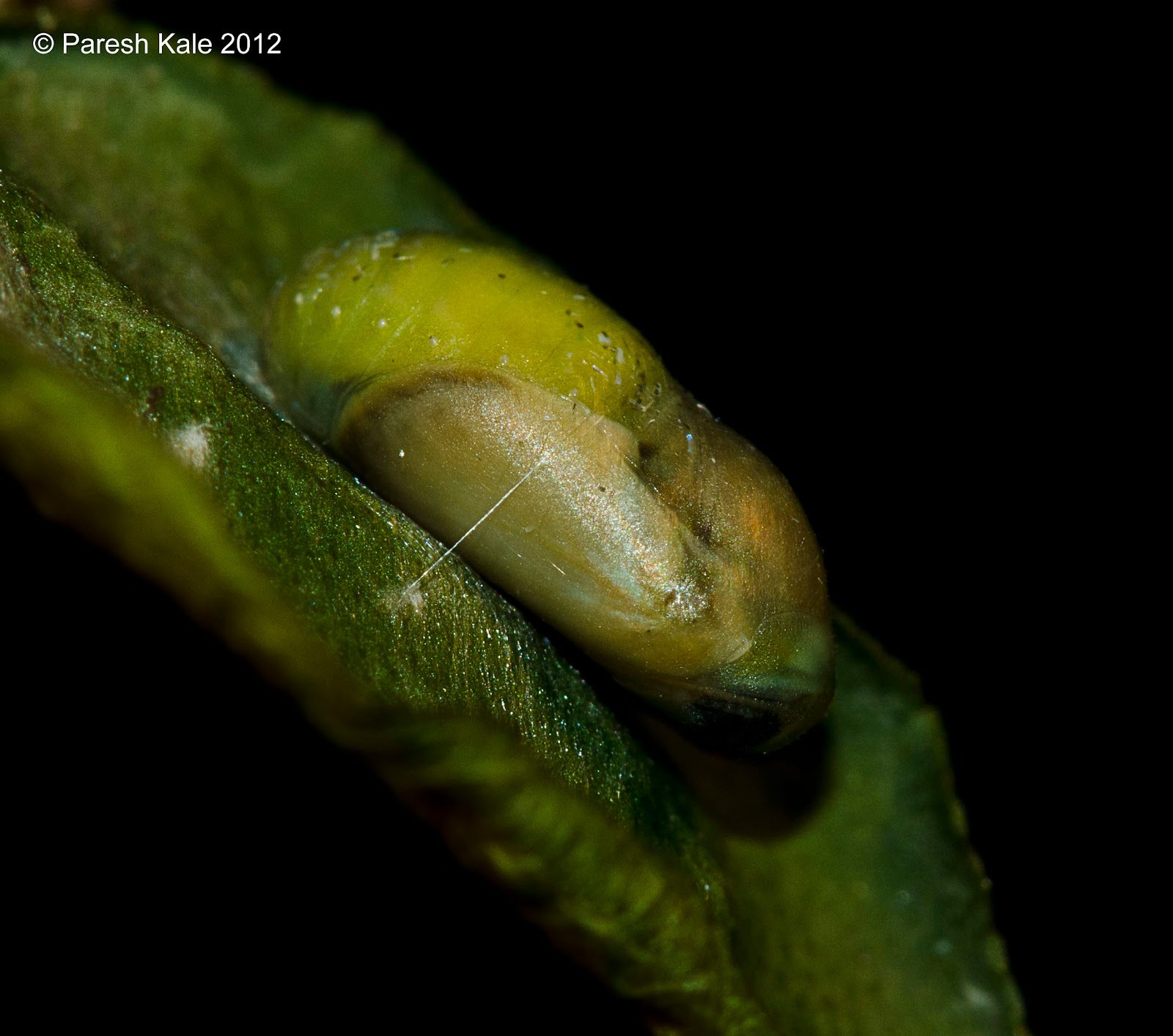
| Top and side view of a Common baron egg laid on Cashew leaf
|
 |
| Zebra blue laying egg on Plumbago. |
Life cycle of a butterfly starts with an egg. Probably most wonderful activity by a tiny creature apart from nectoring. Chain of actions before egg laying adds excitation and sometimes surprise to the nature lover.It all starts with hunt for the right larval host plant. Female hovers over a region to find the appropriate one. Now one has to be ready with the camera and track the lady. Female settles, sits on the prospective surface with curved abdomen, it is the start for the egg laying activity. For cameraman to shoot egg laying activity, getting into right position sometimes a not-easy-to-do job. Furthermore the activity lasts for few seconds in many cases when a single egg is laid. However if multiple eggs are laid then its relatively simple to take best photos. Watching egg laying female is best start to successful life cycle documentation.
 |
| Fresh Egg of common crow, sticky liquid is seen at the base |
Eggs are too tiny, sometimes even for 1:1 macro lens, to take good photos. Best setup would be - a tripod mounted camera with true macro lens and creative lighting system. Sharp and close-up image reveals the features of the egg properly. The ornamentation with ridges, pits, polygonal cells can be seen in best of the image. A thin layer of sticky substance can also be seen. This layer keeps the eggs attached to the surface where it is laid, surface may be a leaf or bud or flower. Normally it takes about 2-4 days to hatch an egg and hatching time depends on the species.
Few observations of egg/s, may lead to conclude about the butterfly species and to determine whether the egg was laid by butterfly or some other insect. Here are some points which can be considered while observing eggs:
 |
| Top view of dome shaped egg of Giant Red Eye |
1. The larval host plant: Every butterfly prefers one out of bunch of preferred plants to lay eggs. This information and verification in the checklist reduces the list of possible candidates to few. For example, If a butterfly egg is found on coconut tree, most likely it would be of common palmfly. Some species need association of ant for caterpillar growth. In such cases, female prefers the plant only if ants are present. On very few occasions, egg is laid in the vicinity of the larval host plant. In this case, caterpillar searches for right plant and starts feeding. A rare case is female making a mistake in identifying the larval host plane. Such "oviposition" mistakes are uncommon but have been reported. Me and Abhay were involved in one such case by common wanderer female. She laid eggs on Ziziphus, which is not a LHP of the species involved. We searched for its usual LHP, Capparis, in the vicinity. We found none.
2. The shape of an egg: It differs from family to family.
a) White and yellows: Eggs like bottle shaped or grain of rice.
b) Swallowtails : Round shape like ball.
c) Blues: Semi-spherical or dome shaped with spines
d) Skippers: dome shaped without any markings
e) Brush-footed butterflies: Half-open flower
3. Number of eggs: Number of eggs laid in a batch depends on the butterfly species. Some lay single egg while some lays many eggs in batches. Number of eggs in batch may vary from a small batch of 2-3 eggs to a big hundred. Egg laying in small batches for few days may happen in case of some species. Common wanderer is observed to lay around 7 eggs in two batches. Small salmon Arab, Tawney Castor may lay around hundred eggs.
4. Location on surface where egg is laid: Leaf of larval host plant is most preferred place to do so. Sometimes its laid under the leaf, over the leaf, on offshoot. Some species choose flowers to lay egg on.
Different types of butterfly eggs

Spherical egg of Common Nawab |

Seven eggs of Common Wanderer, laid in two batches |

Egg of Common Sailor on tip of leaf |

Most likely egg of Dark evening brown |
 |
| Forget-me-not (Catochrysops strabo) egg laying on sprouts of Paracalyx scariosus (Marathi: रान घेवडा ) |
 |
| Dark grass blue laying egg on flower |
References:
1. Butterflies of peninsular India by Dr. Krushnmegh Kunte, 1st Editiion, 2000, University Press Pvt. Ltd.


 Indian sunbeam male and female have distinct UP. Male is bright orange and female with most of the part dull dark brown (Chocolate) colored with small white marking on upper-wing. According to Krushnmegh kunte's "Butterflies of Peninsular India", Males are much more frequently seen. However our observation inside the campus is other way round. Females were spotted often, specially near the host plants. Once female was spotted on bamboo tree sap. Just once Male was seen mud-puddling. Male and female both were shot on that same day behind the H-5/H-9 hostels besides the compound wall. Otherwise, one very few occasions male is seen that too in the flight. Indian sunbeam is frequently found when we toured SGNP, yeoor, Nagla nad Tungareshwar WLS. There are two other subspecies, angled and toothed sunbeam, both spotted by us in Tungareshwar WLS. These two posses subtle deviation from Indian sunbeam and none of them are spotted in the campus.