Pages

Showing posts with label Abhay Soman. Show all posts

Thursday, 15 March 2012

Wandering Destination : Matheran


Road to heaven?...Matheran
A famous tourist weekend destination and hill station. Pollution free zone due to some strict rules regarding vehicles and envioronment. Basically its a plateu at a height of about 1800 mt. Temperature in summer doesent go above 30 deg.cel. Pretty good destination for photography post-monsoon. Stunning waterfalls,  exquisite landscapes, mesmerizing fog, curvy roads, breath taking valleys, grand panoramas, drizzles, in short everything for memorable weekend. Birds in and after winter is good attraction.

We went there for butterflies three times in different season with different approaches. All the three trips proved miserable. Lifers for us was peacock royal sighting. Otherwise the common ones.

To reach Matheran, one can opt by-road option or peaceful local train option. Get down at "Neral" station and take a share taxi to Matheran. Toy train takes pretty long, about 1.5 hours. It may be fun post monsoon. During monsoon the train doesnt run due to land slide dangers. Taxi drops visitor at entrance. No vehicle is allowed further this point. Charge for Neral-matheran taxi is 60 Rs (March 12) and entrance ticket is 25 Rs (March 12). Parking charges as per vehicle type. 


Panoramic view of Matheran valley


Sunday, 11 March 2012

Wandering destination: Around Mumbai


Greater Flamingo at Shivadi


IIT Bombay campus hosts innumerable varieties of birds, flowers, trees and butterflies. However, it has natural and ecological limitations. Every living species around Mumbai cant be seen in the campus. Some of the species are jungle dwellers and prefers thick, unattended forest. For example some butterflies species like Baronet, Tinsel, Western centaur Oakblue are seen in the jungles of SGNP and Tungareshwar WLS but IITB Campus. To explore more wonders about nature, apart from campus, there are some immediate destinations near Mumbai sub-urban. Here is consolidated information about one-day return spots.

Lungs of Mumbai, SGNP
Sanjay Gandhi National Park (SGNP): Campus shares some of its boundaries with SGNP. SGNP, a  protected are of about 104 sq. km., spreads from Borivali to Thane.  An estimated 800 types of flowering plants; 284 kinds of birds; 5,000 species of insects; 36 types of mammals; 62 reptiles and 150 species of butterfly can be found. some distinguished features of the park are nature trails, Karvy flowers blooming after every 7/8 years, Kanheri caves. Ticket for individual is 20 Rs and park can be accessed from 6 AM to 6 PM. From IIT, BEST or NMMT buses drops you at the very entrance of the park. Private vehicles are allowed inside the park with some fees. For trekking and nature trails, prior permission is required.

Jungles in SGNP


Shiwadi bird watching spots
Shivadi: Famous for Flamingo's. Many other water birds (gulls, waders, snipers, herons,etc) can be seen in the mangrove forest. Best time of the day would be morning to visit. The are plenty of spots to seat calmly and watch bird activities. Take a train from Kanjur to Shiwadi, with one change over at Dadar. Start walking towards sea coast and ask for Jetty. Jetty is the best spot among many. Siwari fort could be an attraction for some, Colgate gate is another point to watch birds closely.  


Yeoor Hills: This is entry to SGNP from Thane. Buses from IIT Main gate to Mulund and then catching bus towards yeoor takes about 45 minutes to reach the destination under normal circumstances.


Tata power plant at backdrop, Shivadi

Map of Nagla Block
Nagla: Another extension of SGNP. Its far from the disturbances by the tourists. For butterfly lovers, there can be few surprises post monsoon season. Some exotic species of butterflies like Silver streak Blue, Chocolate Albatross, Orange Awlet, Acacia Blue are often sited. To reach Nagla, take a bus from Main gate to Mulund and then from Mulund to Hotel Fountain. Walk about a kilometer towards Ahmedabad on the highway and there u are. On right side there are some houses and thats the way in to the Nagla block.

Mahim Nature Park: Situated in the midst of city and spread over a large area on the banks of Mithi. Very well maintained and can be good starting point to watch nature closely and comprehensively. It hosts every natural element : birds, butterflies, flowers.Entry fee is 10 rs. Permission required to take photos. A bus from Gandhinagar bus stop drops very near to MNP.

Saturday, 10 March 2012

Acytolepis puspa (Common Hedge Blue)


Acytolepis puspa (Common Hedge Blue) newly emerged.

This is small butterfly predominantly white with series of black spots on its underwing. It belongs to Lycaenidae family. It is not very common in our campus. It can be seen on damp patches and around its host plant Peltophorum ptecocarpum (Copperpod tree). There are many Copperpod trees on both sides of main road. I have seen female laying eggs on such trees once near Canara Bank ATM (near H-6) and near H-8. We also found eggs on another Copperpod tree near Main Building. Female lay egg singly on tender shoot or very young leaves. Eggs is more or less round, bluish green in colour, it turns white on maturity. A caterpillar does not eat its egg shell. It is tiny and extremely camofludged. It exclusively eats tender leaves of plant. After reaching maturity caterpillar turns pinkish-red in colour. One of the caterpillar made pupa on upperside of leaf and the butterfly emerged was male.  


Basking Acytolepis puspa (Common Hedge Blue) Female.
Similar species is Tailess Malayan (Megisba thwaitesi), compare following photo for similarities and differences between Common Hedge Blue and Tailess Malayan. Tailess Malayan is seen while mud-puddling.


Egg of Acytolepis puspa


Pre-pupation

Pre-pupation


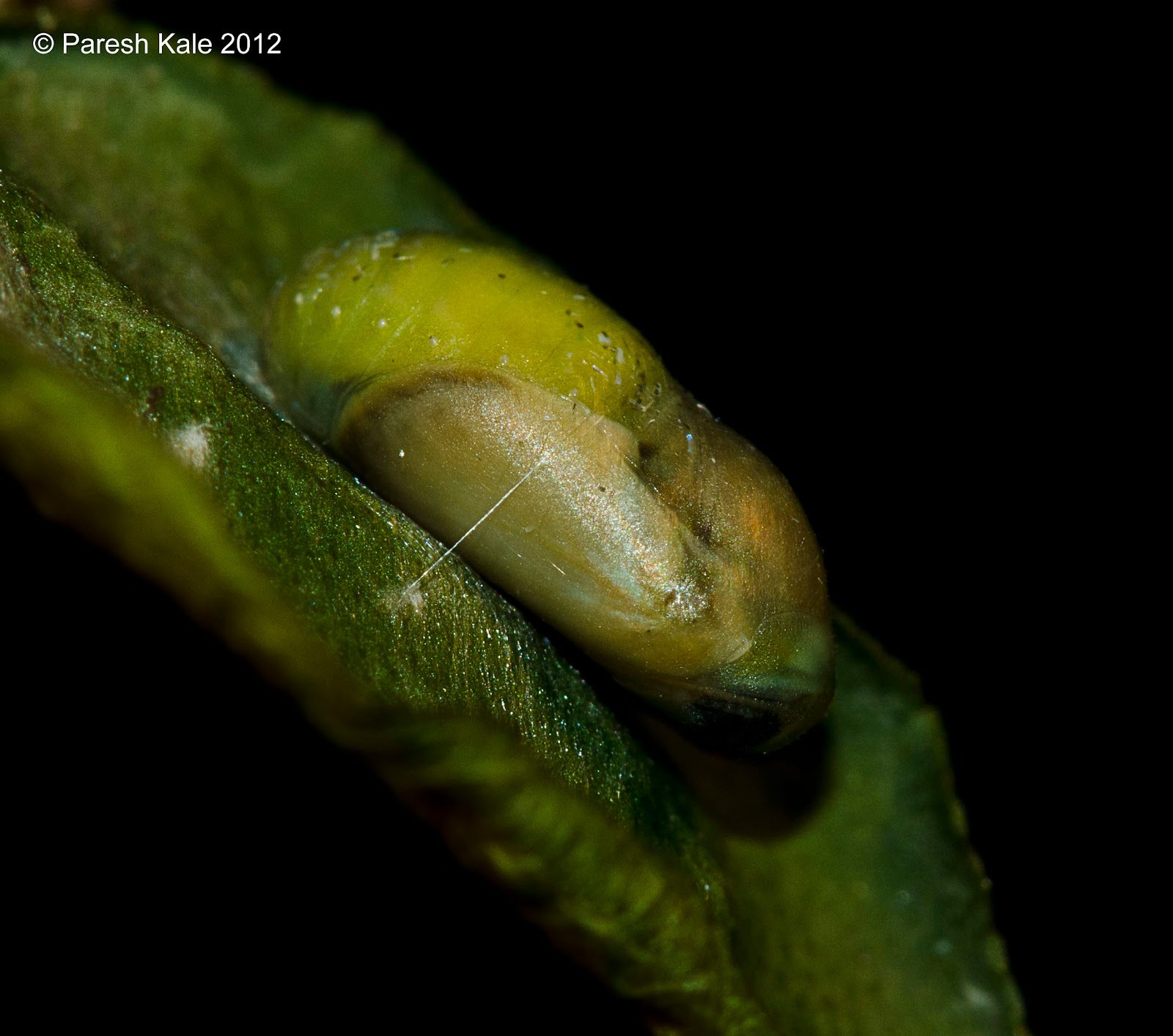
Pupa just before emergence 


Peltophorum ptecocarpum (Copperpod tree)


Acytolepis puspa (Common Hedge Blue) mudpuddling


Euchrysops cnejus (Gram Blue)

Euchrysops cnejus (Gram Blue) newly emerged.
Euchrysops cnejus (Gram Blue) is a small butterfly belonging to lycaenidae family. It is very common in post-mansoon months in our campus. It can often be seen basking along road sides in the morning showing off its beautiful blue colour (in case of male); on upperside of its wings. Two tornal black spots with orange caps are present. It is tailed butterfly.
This butterfly and Forget-me-not butterfly are very much similar and can be confused for one another. Absence of spot in     will imply that it is Forget-me-not (see the comparison photo).
It has been seen laying eggs on Vignata sp. flowers and flower buds. Vignata sp. is a climber and it is common in our campus. It can be readily recognised in post-mansoon months by presence of flowers. Flowers are violet-purple in colour and it has peculiar shape.  Gram Blue caterpillar feeds on inner part of flower buds and inner parts of flowers. In order to feed it bores a hole through flower.  So if you examine the flowers/flower buds with hole you may get to see caterpillar. One should be careful in identifying caterpillar because some other species such as Pea Blue, Common cerulean , Dark cerulean caterpillars look almost same at first glance and moreover they also has Vignata sp. as a common larval host plant. We have seen Dark cerulean activity near Vignata sp.. It should be noted that ants were present on Vignata sp. on which we found Gram Blue caterpillar. But its pupation seems to be unaffected by absence of ants (this was a case as caterpillar was reared in home).  Before pupation caterpillar was constantly moving to find secluded space. Then we put some dried leaves insided the box, where caterpillar was kept. It finally made pupa inside one of the curled, dried leaf.

Key difference between Gram Blue and Forget-me-not.

Open wing


Pre-pupation


Pupa


Before emergence


Emergence


Friday, 9 March 2012

Hasora chromus (Common Banded Awl)

Hasora chromus newly emerged
Like almost all the skippers Hasora chromus (Common Banded Awl) is crepuscular in habit. It can be seen nectoring on Lantana early in the morning or late evening. It is common in post-mansoon months. It has stout body and hence it is very swift flier. Male and female are same in markings on underside of their wings. Male has brands on upperside. Female lays egg singly on tender leaves or shoot of the plant.
We were able to observe its early stages. The caterpillar was found on Pongamia pinnata (करंज[1] behind the convocation hall of IITBombay. It was newly planted there, so height of the tree was ~ 4 feet. The caterpillar was inside the cell  made up of the leaf (see the photo below). The caterpillar came out of the cell to feed, often partly eating its own cell. After finishing off that cell it wandered around to find suitable place to make another cell and so on it continued. It mostly preferred to come out of the in night.
On the same plant we found 3 caterpillar of almost same maturity.  The pupa was white in colour and loosely held by body bands. Again the caterpillar made cell to pupate. Before pupation the caterpillar was almost immovable for a day. It firstly attached its lower end to leaf and then its skin slowly ruptured. This process took almost a day. 
We have seen 5-6 female Hasora chromus laying eggs on newly blossom Pongamia pinnata near Hostel-13. (We have seen Pongamia pinnata blossoming at end February). Pongamia pinnata may be the preferred larval host plant for this species (at least in our campus); because this plant is present almost everywhere.
Reported larval host plants [2] are: Pongamia pinnataRicinus communis, Trichilia connaroides.


Contributors: Swapnil Lokhande and Abhay Soman.


Pongamia pinnat (Marathi:  करंज)

 
Hasora chromus egg laying on Pongamia pinnata (Marathi:करंज)


Caterpillar of Hasora chromus. Inset: cell

Pre-pupation

Pupation


Pupa of Hasora chromus


References:
[1] Wikipedia entry of Pongamia pinnata.
[2] Kunte K. "Butterflies of peninsular India".

Lime Blue (Chilades laius)


Fresh Lime Blue 

Lime Blue female egg laying on Lime
Lime Blue (Chilades laius) belongs to Lycaenidae family. It is small butterfly, grayish in colorWe were able to observe its life-cycle. As its name suggest its larval host plants includes Lime plants. We observed its larva on small lime tree in Medical garden. Larva was easy to detect even though it is well camouflaged. Ants constantly follow larva, so in order to find Lime Blue's larva just follow the trail of ants. On the same plant we were able to find many empty pupa. This plant had many curled leaves. Lime blue caterpillar took advantage of this to make the pupa. Pupa were well concealed inside curled leaves of plant. It seemed that ants were attaining pupa also. We saw two pupa made very near to each other on same curled leaf. Lime Blue is seemed to be common in immediate post mansoon months. Again they were mainly encountered around Hill side. 


Lime Blue pupa in secluded leaf of lime, held on palm 
Key to ID this butterfly is the "L"shaped dots on its hind wings. Sex are dissimilar, female has black outlines on UP, which are absent in male. Here is a video Describing association of ants with lime blue caterpillar on lime tree.


Quick Facts:
Common Name: Lime Blue
Scientific Name: Chilades laius
Wingspan: approx 25-20 mm
Status: Locally Common.

Contributors: Paresh Kale and Abhay Soman.

Caterpillar of Lime Blue (Chilades laius)

Lime Blue
Pulpit rock
Female
Pulpit rock
Male
Pulpit rock
Early stage Pupa
Pulpit rock
Early Stage Pupa
Pulpit rock
Pupa just before eclosion
Pulpit rock
Pupa Just before eclosion
Pulpit rock
A different specimen