|
| Indian Sunbeam female, recently ecloded |
 |
| Fresh egg of Indian sunbeam on Derris scandens |
Indian sunbeam, share a "not common" status with some other butterflies on the campus. Mostly spotted on the lake side, due to unprecedented availability of its LHP, an evergreen climber
named Jewel Vine (
Derris scandens). Thanks Mr. Haneesh for identification. Sunbeam caterpillars were also found on the
Pongamia pinnata (करंज), a pea family tree better known for bio-diesel extraction source. Teh tree also hosts for several other butterflies e.g. Common Banded Awl.
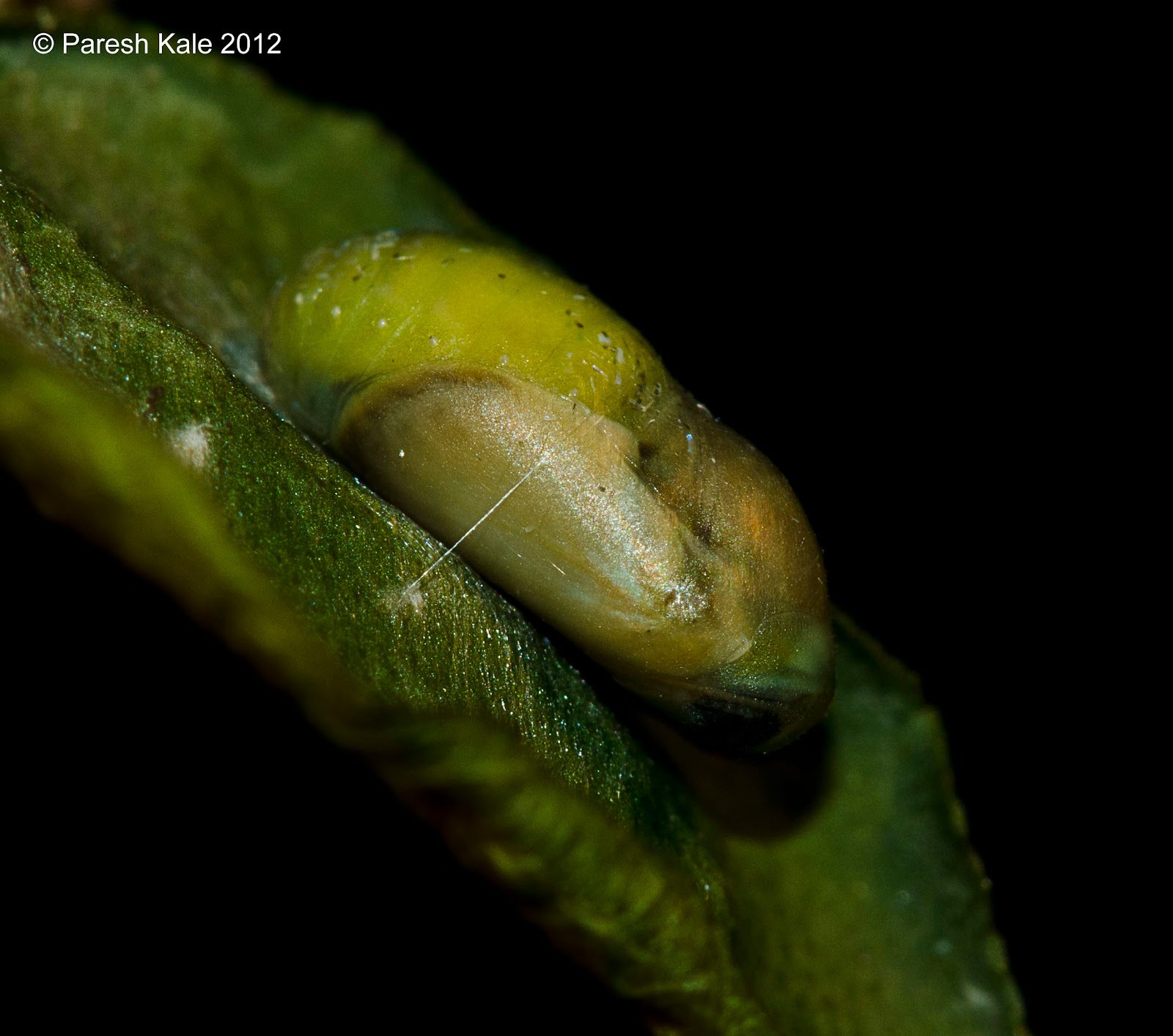
Many eggs and caterpillars were observed at same time on both these plants . Caterpillar normally resides at the edge of the branch and prefers to eat fresh leaves. Due to its excellent camouflage technique it look like a part of leaf, it can remain unnoticed. Two horn-like structure on its rare part of the body is a special and noticeable feature.

Indian sunbeam male and female have distinct UP. Male is bright orange and female with most of the part dull dark brown (Chocolate) colored with small white marking on upper-wing. According to Krushnmegh kunte's "Butterflies of Peninsular India", Males are much more frequently seen. However our observation inside the campus is other way round. Females were spotted often, specially near the host plants. Once female was spotted on bamboo tree sap. Just once Male was seen mud-puddling. Male and female both were shot on that same day behind the H-5/H-9 hostels besides the compound wall. Otherwise, one very few occasions male is seen that too in the flight. Indian sunbeam is frequently found when we toured SGNP, yeoor, Nagla nad Tungareshwar WLS. There are two other subspecies, angled and toothed sunbeam, both spotted by us in Tungareshwar WLS. These two posses subtle deviation from Indian sunbeam and none of them are spotted in the campus.
Quick Facts:
Name: Indian Sunbeam
Scientific Name: Curtis thetis
Wingspan: 40-50 mm
ID marks: Different UP . Male has orange and female Dark-brown UP wings.
Host plant: Pongamia pinnata, Derris scandens
 |
| Curetis thetis egg laying on Derris scandens |
 |
| Indian Sunbeam Male |


 Indian sunbeam male and female have distinct UP. Male is bright orange and female with most of the part dull dark brown (Chocolate) colored with small white marking on upper-wing. According to Krushnmegh kunte's "Butterflies of Peninsular India", Males are much more frequently seen. However our observation inside the campus is other way round. Females were spotted often, specially near the host plants. Once female was spotted on bamboo tree sap. Just once Male was seen mud-puddling. Male and female both were shot on that same day behind the H-5/H-9 hostels besides the compound wall. Otherwise, one very few occasions male is seen that too in the flight. Indian sunbeam is frequently found when we toured SGNP, yeoor, Nagla nad Tungareshwar WLS. There are two other subspecies, angled and toothed sunbeam, both spotted by us in Tungareshwar WLS. These two posses subtle deviation from Indian sunbeam and none of them are spotted in the campus.