Pages

Showing posts with label Macro Photography. Show all posts

Thursday, 15 March 2012

Wandering Destination : Matheran


Road to heaven?...Matheran
A famous tourist weekend destination and hill station. Pollution free zone due to some strict rules regarding vehicles and envioronment. Basically its a plateu at a height of about 1800 mt. Temperature in summer doesent go above 30 deg.cel. Pretty good destination for photography post-monsoon. Stunning waterfalls,  exquisite landscapes, mesmerizing fog, curvy roads, breath taking valleys, grand panoramas, drizzles, in short everything for memorable weekend. Birds in and after winter is good attraction.

We went there for butterflies three times in different season with different approaches. All the three trips proved miserable. Lifers for us was peacock royal sighting. Otherwise the common ones.

To reach Matheran, one can opt by-road option or peaceful local train option. Get down at "Neral" station and take a share taxi to Matheran. Toy train takes pretty long, about 1.5 hours. It may be fun post monsoon. During monsoon the train doesnt run due to land slide dangers. Taxi drops visitor at entrance. No vehicle is allowed further this point. Charge for Neral-matheran taxi is 60 Rs (March 12) and entrance ticket is 25 Rs (March 12). Parking charges as per vehicle type. 


Panoramic view of Matheran valley


Sunday, 11 March 2012

Wandering destination: Around Mumbai


Greater Flamingo at Shivadi


IIT Bombay campus hosts innumerable varieties of birds, flowers, trees and butterflies. However, it has natural and ecological limitations. Every living species around Mumbai cant be seen in the campus. Some of the species are jungle dwellers and prefers thick, unattended forest. For example some butterflies species like Baronet, Tinsel, Western centaur Oakblue are seen in the jungles of SGNP and Tungareshwar WLS but IITB Campus. To explore more wonders about nature, apart from campus, there are some immediate destinations near Mumbai sub-urban. Here is consolidated information about one-day return spots.

Lungs of Mumbai, SGNP
Sanjay Gandhi National Park (SGNP): Campus shares some of its boundaries with SGNP. SGNP, a  protected are of about 104 sq. km., spreads from Borivali to Thane.  An estimated 800 types of flowering plants; 284 kinds of birds; 5,000 species of insects; 36 types of mammals; 62 reptiles and 150 species of butterfly can be found. some distinguished features of the park are nature trails, Karvy flowers blooming after every 7/8 years, Kanheri caves. Ticket for individual is 20 Rs and park can be accessed from 6 AM to 6 PM. From IIT, BEST or NMMT buses drops you at the very entrance of the park. Private vehicles are allowed inside the park with some fees. For trekking and nature trails, prior permission is required.

Jungles in SGNP


Shiwadi bird watching spots
Shivadi: Famous for Flamingo's. Many other water birds (gulls, waders, snipers, herons,etc) can be seen in the mangrove forest. Best time of the day would be morning to visit. The are plenty of spots to seat calmly and watch bird activities. Take a train from Kanjur to Shiwadi, with one change over at Dadar. Start walking towards sea coast and ask for Jetty. Jetty is the best spot among many. Siwari fort could be an attraction for some, Colgate gate is another point to watch birds closely.  


Yeoor Hills: This is entry to SGNP from Thane. Buses from IIT Main gate to Mulund and then catching bus towards yeoor takes about 45 minutes to reach the destination under normal circumstances.


Tata power plant at backdrop, Shivadi

Map of Nagla Block
Nagla: Another extension of SGNP. Its far from the disturbances by the tourists. For butterfly lovers, there can be few surprises post monsoon season. Some exotic species of butterflies like Silver streak Blue, Chocolate Albatross, Orange Awlet, Acacia Blue are often sited. To reach Nagla, take a bus from Main gate to Mulund and then from Mulund to Hotel Fountain. Walk about a kilometer towards Ahmedabad on the highway and there u are. On right side there are some houses and thats the way in to the Nagla block.

Mahim Nature Park: Situated in the midst of city and spread over a large area on the banks of Mithi. Very well maintained and can be good starting point to watch nature closely and comprehensively. It hosts every natural element : birds, butterflies, flowers.Entry fee is 10 rs. Permission required to take photos. A bus from Gandhinagar bus stop drops very near to MNP.

Saturday, 10 March 2012

Common Baron (Euthalia aconthea)


Common baron is a common medium sized graceful butterfly. Brown in color, female and male differs slightly on upper wings. Female has prominent white spots on upper-side. Species can be confused with chocolate pansy.  Female is seen quite often basking on the big leaf. Having large abdomen, powers it a powerful flight. To find a baron male is a rare treat to the eyes. Male can be found near wet patches, puddling during noon time. Egg is laid singly, preferred LHP is cashew-nut. Egg is domed shape, green in color and has spines all over it. Caterpillar rests on upper side of the leaf, aligned with the mid-rib. Its spiny and looks like thin lines of the leaf. Even being on the upper side of the leaf, camouflage protects it. When grown enough, it forms a pupa below the leaf. Its attached to the leaf with "cremaster". Pupa is often parasitized  by chalcid wasps [1]. 

Front and side view of common baron egg on cashew-nut leaf

Quick Facts:
Name: Common Baron
Scientific Name: Euthalia aconthea
Wingspan : 50 to 60 mm
Host plant: Mango, cashew-nut


Baron cat on cashew=nut leaf
Pupa


Female basking

Cashew-nut tree, with fruit and flowers
Mango tree, Mangifera Indica


Butterfly predators


Impeccable Yellow spider in action

 Butterfly is lower order species of the food chain. Its eaten by many of the predators in every life stage of its. Most common ones are birds, spiders, robber fly and wasps. Birds and spiders catch them full grown. An interesting video was captured by Swapnil Lokhande, in which a bird is seen with a butterfly. Bird seems enjoying the meal, the butterfly being eaten was Tawney Rajah. It was sad part for us as Tawney Rajah is seen quite rarely on campus.

Common wanderer caught by spider
Spiders normally seats on the flower and wait for the prey to appear for nectoring. It seats quietly and camouflages excellently with the flower. After setting himself up, its mere the luck of the butterfly decides. Set-up hardly misses any butterfly and rarely seen one escaping the trap. A small spider can catch large butterflies as well. We have seen a common wanderer male caught by a small spider before our eye could blink. Spider takes a long time to kill the prey and eats slowly. Spider net is also used by certain spiders species to catch the insects. Butterflies with large wingspan are primary victims, due to size easily gets entangled in the web.

Close view of white spider on pink-white flower

 
Spider chasing Pierrot 


Robber fly with catch,  grass yellow is the victim
Insects in the dipters family asilidae are commonly called robber flies. Catches for almost every kind of small insect, list is long. List includes butterflies, beetles, moths, bees, ants, dragonflies, damselflies, some wasps, grasshoppers and even spiders [1]. Wasps lay eggs inside the pupa pinning them and the babies after hatching out eats caterpillar inside pupa. Infected pupa can be easily identified. Spoiled pupa changes color to dark black after few days and doesn't pupate. On campus, tiger species and Tailed jay pupa's commonly found infected by some wasps.Some wasps may even infect a caterpillar and feed on it.

Lime cat attacked by wasps

Dragonflies finds a butterfly


Reference:
[1] http://en.wikipedia.org/wiki/Asilidae

Indian Sunbeam (Curetis thetis)


Indian Sunbeam female, recently ecloded

Fresh egg of Indian sunbeam on Derris scandens
         Indian sunbeam, share a "not common" status with some other butterflies on the campus. Mostly spotted on the lake side, due to unprecedented availability of its LHP, an evergreen climber named Jewel Vine (Derris scandens). Thanks Mr. Haneesh for identification. Sunbeam caterpillars were also found on the Pongamia pinnata (करंज), a pea family tree better known for bio-diesel extraction source. Teh tree also hosts for several other butterflies e.g. Common Banded Awl. Many eggs and caterpillars were observed at same time on both these plants . Caterpillar normally resides at the edge of the branch and prefers to eat fresh leaves. Due to its excellent camouflage technique it look like a part of leaf, it can remain unnoticed. Two horn-like structure on its rare part of the body is a special and noticeable feature.

            Indian sunbeam male and female have distinct UP. Male is bright orange and female with most of the part dull dark brown (Chocolate) colored with small white marking on upper-wing. According to Krushnmegh kunte's "Butterflies of Peninsular India", Males are much more frequently seen. However our observation inside the campus is other way round. Females were spotted often, specially near the host plants. Once female was spotted on bamboo tree sap. Just once Male was seen mud-puddling. Male and female both were shot on that same day behind the H-5/H-9 hostels besides the compound wall. Otherwise, one very few occasions male is seen that too in the flight.  Indian sunbeam is frequently found when we toured SGNP, yeoor, Nagla nad Tungareshwar WLS. There are two other subspecies, angled and toothed sunbeam, both spotted by us in Tungareshwar WLS. These two posses subtle deviation from Indian sunbeam and none of them are spotted in the campus. 

Quick Facts:

Name: Indian Sunbeam
Scientific Name: Curtis thetis
Wingspan: 40-50 mm
ID marks: Different UP . Male has orange and female Dark-brown UP wings.
Host plant: Pongamia pinnata, Derris scandens

Curetis thetis egg laying on Derris scandens
Indian Sunbeam Male
Female UP


Note the horn like body-part

Caterpillar, another view
Fresh pupa

Markings are developed on 4th day

Just before eclosion
Indian Sunbeam female on bamboo tree sap


Some poems

Here are few interesting poems related to nature. Photograph composed to way space to the poems. 

Flower : by Ravindranath Tagore. Flower: Hibiscus

Hugos " Flower to butterfly" by Eugene Field, along with fresh Common Mormon butterfly


From Cocoon forth a butterfly by Emily Dickinson and fresh common emigrant

Angles for butterfly photography


Army of bluebottles puddling

Photography of a full grown butterfly can be divided into two categories : Documentary and Artistic. In this post I will be discussing both of them in details with some interesting examples. Many photographers hesitate to move, bend and sometimes laying on the ground. Simply taking the photograph from the angle you first see it, does not makes a great photo. As a thumb-rule, for every purpose of butterfly photography and butterfly activity, there exist a typical angle to shoot. However this rule doesn't apply for artistic photography.

A. Butterfly Documentary Photography:
Purpose of this kind is help for identification, spot record and documentation.


1. Closed wing / Under wing (UN) shot:  In case of some species like lascar, sailor this shot is of utmost importance in identification process. A perfect UN photo is needed to see all the marking on the wing neatly. To accomplish, this one has to wait for butterfly to close its wings and settlement. During nectoring, butterfly seats on the flower. If the flower is not high enough, one needs to to bend. Otherwise one has to adjust the height accordingly.

After this, photographer should get in a place where camera is exactly perpendicular to the wings of the butterfly. Such angle covers the whole wing. It also helps to have lower aperture number, as depth of field required would be very shallow. Lower f-number will help to choose higher shutter speeds (improves sharpness of the photograph) and lower depth of field will impart nice bokeh to the image. Both features will enhance the beauty of the photo and additionally will make a perfect picture for documentation. This position of camera/photographer is much important when shooting mud-puddling butterflies.

One has to lay down flat on the ground to shoot in this angle. Often, photographers keeps standing and shoot mud puddling butterfly. This gives a slant and partial view of the same. If one cant lay down on ground, camera with veri-angle screen e.g. Canon 30X, Canon 60D etc is useful. Veri-anlge LCD will help to keep camera on ground and then tilting the LCD to view, focus and compose the image. Another case for a closed wing would be when  butterfly is resting on some small object with wings complete open. This can also provide under wing shot, small object hiding some part of the body.


Use of veri-angle or tilting LCD for mud-puddling butterfly


2. Open wing / upper wing (UP) shot: Apart from help in ID, Open wing shot often helps in differentiating male and female. There can be two occasions to get complete open wing shot of a butterfly: While basking or while mud-puddling. In the morning, butterfly often seats on a large leaf with wings flat open. This is in order to dry there wet wings because of dew. Most butterflies seats at suitable height for photographing, specially the small ones like plains cupid, line blues, lime blue etc. Some like Tawney rajah seats on a big leaf at some height, not reachable, making ti difficult to photograph. Again for a perfect open wing shot one should bring lens axis perpendicular to the plane of the wings spread. Advantages are same as stated in closed wing shot.

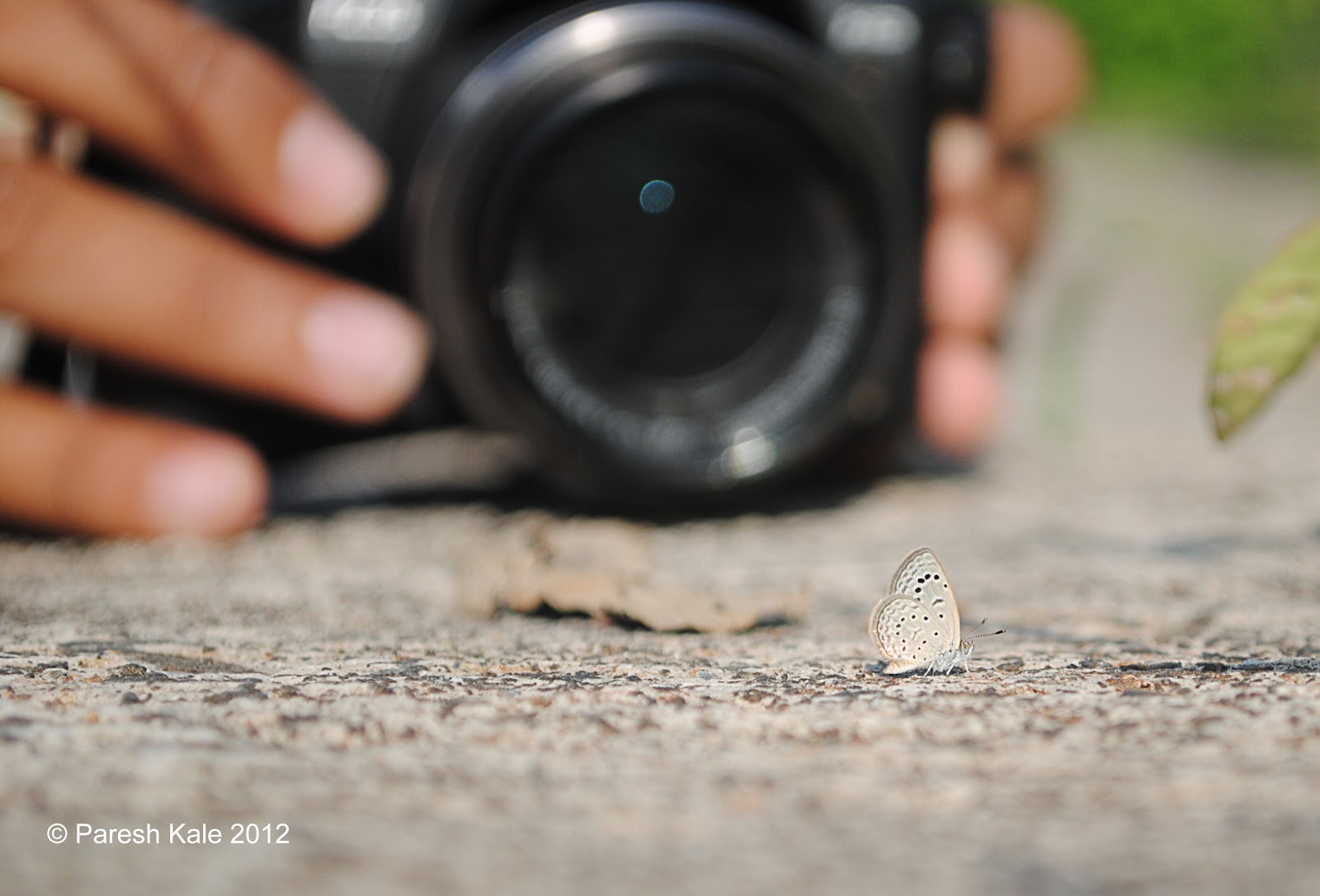
Perfect angle of tiny butterflies is sometimes intriguing


3. Miscellaneous shots: On very rare occasions, shot of the antenna is required. The angle to shoot whole of the antenna would be perpendicular to the plane of the antenna. This is critical shot, as one must shoot it at 1:1 macro. 

B. Butterfly Artistic Photography: 
Shot this beauty from the front while mud-puddling
        Although, every perfect and sharp shot taken with documentary kind of angle will be artistically appreciable I wish to mention some angles in this category. My personal favorite is the front angle. Eyes of butterfly is a striking feature when shot closely. A complex-eye structure is fabulous when seen in close-up. When shot from front side of the butterfly, during nectoring or mud-puddling, both eyes are captured. Mud-puddling is the best opportunity to have such shot. Added advantage in this case is the proboscis inserted in the ground. Another angle would be from behind of the butterfly. Almost every butterfly has dummy eyes like markings on its hind-wings. This is to create an illusion and in order to protect butterflies from predators like bird. These eyes and sometimes tails can be interesting to watch.


Eiffel tower like pose of apefly

Example of wallpaper angle
Another interesting  but difficult-to-achieve angle is : wallpaper angle. When butterfly opens its wings partially during nectoring or mud-puddling, one can photograph the pose at 45 degree angle. This covers almost every part of butterfly, although partially. It creates nice blur effect to out of depth of field parts.

A high angle would be interesting when shooting a butterfly with open wings and sitting at some height above photographers head. Eye can be focused perfectly, while making the rest of body blur by choosing lowest possible aperture. Photographing sailors with this angle would be a good net practice . Sailor like butterflies often seats in such position. 


High angle of common sailor

High angle of common sailor, another one

Monday, 5 March 2012

Butterfly Egg


Top and side view of a Common baron egg laid on Cashew leaf

Zebra blue laying egg on Plumbago.
     Life cycle of a butterfly starts with an egg. Probably most wonderful activity by a tiny creature apart from nectoring. Chain of actions before egg laying adds excitation and sometimes surprise to the nature lover.It all starts with hunt for the right larval host plant. Female hovers over a region to find the appropriate one. Now one has to be ready with the camera and track the lady. Female settles, sits on the prospective surface with curved abdomen, it is the start for the egg laying activity. For cameraman to shoot egg laying activity, getting into right position sometimes a not-easy-to-do job. Furthermore the activity lasts for few seconds in many cases when a single egg is laid. However if multiple eggs are laid then its relatively simple to take best photos. Watching egg laying female is best start to  successful life cycle documentation.


Fresh Egg of common crow, sticky liquid is seen at the base
         Eggs are too tiny, sometimes even for 1:1 macro lens, to take good photos. Best setup would be - a tripod mounted camera with true macro lens and creative lighting system. Sharp and close-up image reveals the features of the egg properly. The ornamentation with ridges, pits, polygonal cells can be seen in best of the image. A thin layer of sticky substance can also be seen. This layer keeps the eggs attached to the surface where it is laid, surface may be a leaf or bud or flower. Normally it takes about 2-4 days to hatch an egg and hatching time depends on the species.


       Few observations of egg/s, may lead to conclude about the butterfly species and to determine whether the egg was laid by butterfly or some other insect. Here are some points which can be considered while observing eggs:

Top view of dome shaped egg of Giant Red Eye
1. The larval host plant: Every butterfly prefers one out of bunch of preferred plants to lay eggs. This information and verification in the checklist reduces the list of possible candidates to few.  For example, If a butterfly egg is found on coconut tree, most likely it would be of common palmfly. Some species need association of ant for caterpillar growth. In such cases, female prefers the plant only if ants are present. On very few occasions, egg is laid in the vicinity of the larval host plant. In this case, caterpillar searches for right plant and starts feeding. A rare case is female making a mistake in identifying the larval host plane. Such "oviposition" mistakes are uncommon but have been  reported. Me and Abhay were involved in one such case by common wanderer female. She laid eggs on Ziziphus, which is not a LHP of the species involved. We searched for its usual LHP, Capparis, in the vicinity. We found none. 

2. The shape of an egg: It differs from family to family. 
     a) White and yellows: Eggs like bottle shaped or grain of rice.
     b) Swallowtails : Round shape like ball.
     c) Blues: Semi-spherical or dome shaped with spines
     d) Skippers: dome shaped without any markings
     e) Brush-footed butterflies: Half-open flower 

3. Number of eggs: Number of eggs laid in a batch depends on the butterfly species. Some lay single egg while some lays many eggs in batches. Number of eggs in batch may vary from a small batch of 2-3 eggs to a big hundred. Egg laying in small batches for few days may happen in case of some species. Common wanderer is observed to lay around 7 eggs in two batches. Small salmon Arab, Tawney Castor may lay around hundred eggs.

4. Location on surface where egg is laid: Leaf of larval host plant is most preferred place to do so. Sometimes its laid under the leaf, over the leaf, on offshoot. Some species choose flowers to lay egg on. 


Different types of butterfly eggs
Pulpit rock
Spherical egg of Common Nawab
Pulpit rock
Seven eggs of Common Wanderer, laid in two batches
Pulpit rock
Egg of Common Sailor on tip of leaf
Pulpit rock
Most likely egg of Dark evening brown
Forget-me-not (Catochrysops strabo) egg laying on sprouts of Paracalyx scariosus  (Marathi: रान घेवडा )

Dark grass blue laying egg on flower


References: 

1. Butterflies of peninsular India by Dr. Krushnmegh Kunte, 1st Editiion, 2000, University Press Pvt. Ltd.