Butterfly is lower order species of the food chain. Its eaten by many of the predators in every life stage of its. Most common ones are birds, spiders, robber fly and wasps. Birds and spiders catch them full grown. An interesting video was captured by Swapnil Lokhande, in which a bird is seen with a butterfly. Bird seems enjoying the meal, the butterfly being eaten was Tawney Rajah. It was sad part for us as Tawney Rajah is seen quite rarely on campus.
Common wanderer caught by spider
Spiders normally seats on the flower and wait for the prey to appear for nectoring. It seats quietly and camouflages excellently with the flower. After setting himself up, its mere the luck of the butterfly decides. Set-up hardly misses any butterfly and rarely seen one escaping the trap. A small spider can catch large butterflies as well. We have seen a common wanderer male caught by a small spider before our eye could blink. Spider takes a long time to kill the prey and eats slowly. Spider net is also used by certain spiders species to catch the insects. Butterflies with large wingspan are primary victims, due to size easily gets entangled in the web.
Close view of white spider on pink-white flower
Spider chasing Pierrot
Robber fly with catch, grass yellow is the victim
Insects in the dipters family asilidae are commonly called robber flies. Catches for almost every kind of small insect, list is long. List includes butterflies, beetles, moths, bees, ants, dragonflies, damselflies, some wasps, grasshoppers and even spiders [1].Wasps lay eggs inside the pupa pinning them and the babies after hatching out eats caterpillar inside pupa. Infected pupa can be easily identified. Spoiled pupa changes color to dark black after few days and doesn't pupate. On campus, tiger species and Tailed jay pupa's commonly found infected by some wasps.Some wasps may even infect a caterpillar and feed on it.
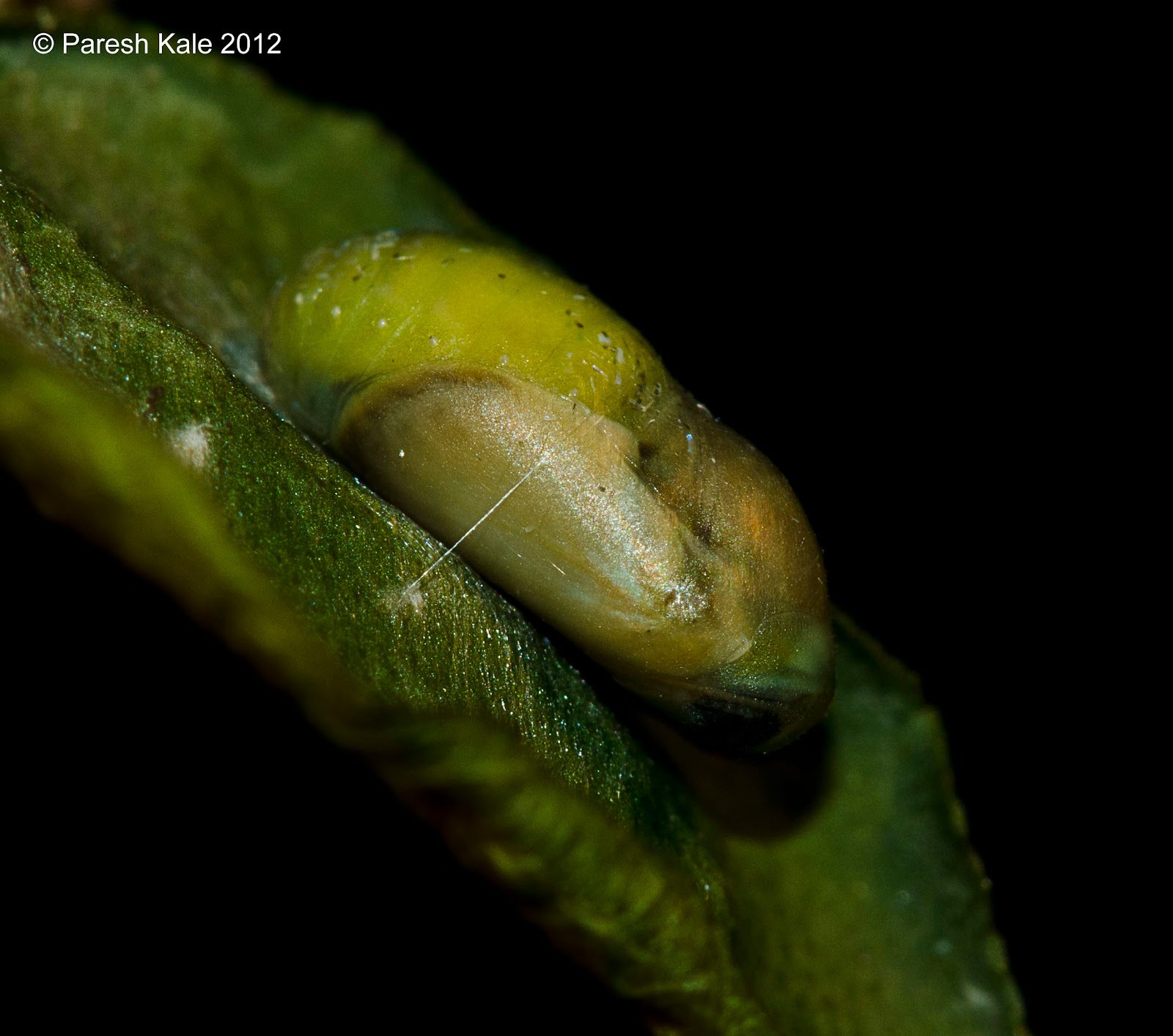
Lime Blue (Chilades laius) belongs to Lycaenidae family. It is small butterfly, grayish in color. We were able to observe its life-cycle. As its name suggest its larval host plants includes Lime plants. We observed its larva on small lime tree in Medical garden. Larva was easy to detect even though it is well camouflaged. Ants constantly follow larva, so in order to find Lime Blue's larva just follow the trail of ants. On the same plant we were able to find many empty pupa. This plant had many curled leaves. Lime blue caterpillar took advantage of this to make the pupa. Pupa were well concealed inside curled leaves of plant. It seemed that ants were attaining pupa also. We saw two pupa made very near to each other on same curled leaf. Lime Blue is seemed to be common in immediate post mansoon months. Again they were mainly encountered around Hill side.
Lime Blue pupa in secluded leaf of lime, held on palm
Key to ID this butterfly is the "L"shaped dots on its hind wings. Sex are dissimilar, female has black outlines on UP, which are absent in male. Here is a video Describing association of ants with lime blue caterpillar on lime tree.
Quick Facts: Common Name: Lime Blue Scientific Name:Chilades laius Wingspan: approx 25-20 mm Status: Locally Common.