Pages

Showing posts with label pupa. Show all posts

Saturday, 10 March 2012

Acytolepis puspa (Common Hedge Blue)


Acytolepis puspa (Common Hedge Blue) newly emerged.

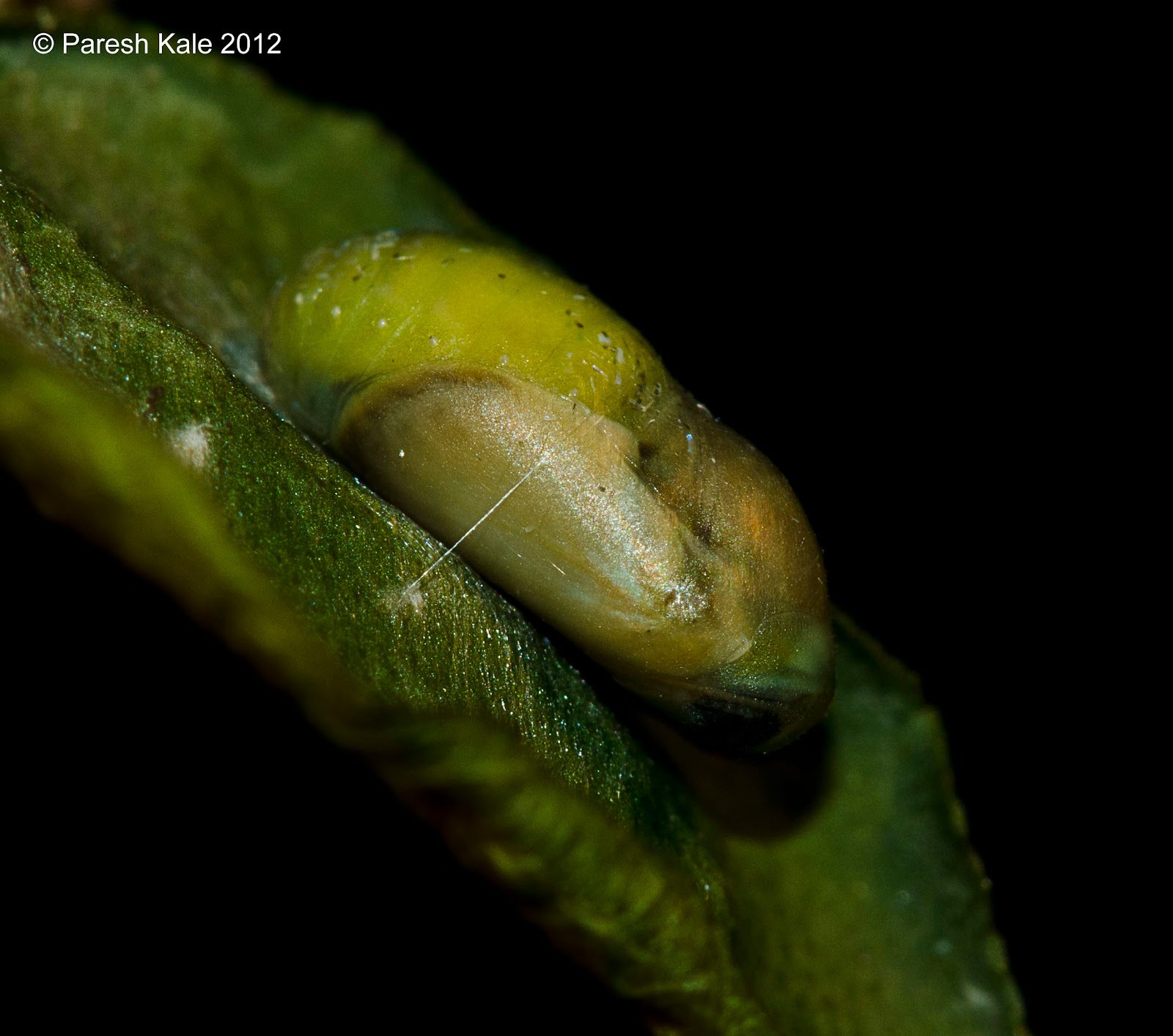
This is small butterfly predominantly white with series of black spots on its underwing. It belongs to Lycaenidae family. It is not very common in our campus. It can be seen on damp patches and around its host plant Peltophorum ptecocarpum (Copperpod tree). There are many Copperpod trees on both sides of main road. I have seen female laying eggs on such trees once near Canara Bank ATM (near H-6) and near H-8. We also found eggs on another Copperpod tree near Main Building. Female lay egg singly on tender shoot or very young leaves. Eggs is more or less round, bluish green in colour, it turns white on maturity. A caterpillar does not eat its egg shell. It is tiny and extremely camofludged. It exclusively eats tender leaves of plant. After reaching maturity caterpillar turns pinkish-red in colour. One of the caterpillar made pupa on upperside of leaf and the butterfly emerged was male.  


Basking Acytolepis puspa (Common Hedge Blue) Female.
Similar species is Tailess Malayan (Megisba thwaitesi), compare following photo for similarities and differences between Common Hedge Blue and Tailess Malayan. Tailess Malayan is seen while mud-puddling.


Egg of Acytolepis puspa


Pre-pupation

Pre-pupation


Pupa just before emergence 


Peltophorum ptecocarpum (Copperpod tree)


Acytolepis puspa (Common Hedge Blue) mudpuddling


Commander - Life Cycle

Please double-click on the picture for better quality. 


Common Baron (Euthalia aconthea)


Common baron is a common medium sized graceful butterfly. Brown in color, female and male differs slightly on upper wings. Female has prominent white spots on upper-side. Species can be confused with chocolate pansy.  Female is seen quite often basking on the big leaf. Having large abdomen, powers it a powerful flight. To find a baron male is a rare treat to the eyes. Male can be found near wet patches, puddling during noon time. Egg is laid singly, preferred LHP is cashew-nut. Egg is domed shape, green in color and has spines all over it. Caterpillar rests on upper side of the leaf, aligned with the mid-rib. Its spiny and looks like thin lines of the leaf. Even being on the upper side of the leaf, camouflage protects it. When grown enough, it forms a pupa below the leaf. Its attached to the leaf with "cremaster". Pupa is often parasitized  by chalcid wasps [1]. 

Front and side view of common baron egg on cashew-nut leaf

Quick Facts:
Name: Common Baron
Scientific Name: Euthalia aconthea
Wingspan : 50 to 60 mm
Host plant: Mango, cashew-nut


Baron cat on cashew=nut leaf
Pupa


Female basking

Cashew-nut tree, with fruit and flowers
Mango tree, Mangifera Indica


Friday, 9 March 2012

Lime Blue (Chilades laius)


Fresh Lime Blue 

Lime Blue female egg laying on Lime
Lime Blue (Chilades laius) belongs to Lycaenidae family. It is small butterfly, grayish in colorWe were able to observe its life-cycle. As its name suggest its larval host plants includes Lime plants. We observed its larva on small lime tree in Medical garden. Larva was easy to detect even though it is well camouflaged. Ants constantly follow larva, so in order to find Lime Blue's larva just follow the trail of ants. On the same plant we were able to find many empty pupa. This plant had many curled leaves. Lime blue caterpillar took advantage of this to make the pupa. Pupa were well concealed inside curled leaves of plant. It seemed that ants were attaining pupa also. We saw two pupa made very near to each other on same curled leaf. Lime Blue is seemed to be common in immediate post mansoon months. Again they were mainly encountered around Hill side. 


Lime Blue pupa in secluded leaf of lime, held on palm 
Key to ID this butterfly is the "L"shaped dots on its hind wings. Sex are dissimilar, female has black outlines on UP, which are absent in male. Here is a video Describing association of ants with lime blue caterpillar on lime tree.


Quick Facts:
Common Name: Lime Blue
Scientific Name: Chilades laius
Wingspan: approx 25-20 mm
Status: Locally Common.

Contributors: Paresh Kale and Abhay Soman.

Caterpillar of Lime Blue (Chilades laius)

Lime Blue
Pulpit rock
Female
Pulpit rock
Male
Pulpit rock
Early stage Pupa
Pulpit rock
Early Stage Pupa
Pulpit rock
Pupa just before eclosion
Pulpit rock
Pupa Just before eclosion
Pulpit rock
A different specimen


Tuesday, 6 March 2012

Red Pierrot - Lifecycle


Fresh specimen of Red Pierrot

One of the common butterfly on the campus for entire year. A tiny and unmistakable butterfly with very weak flight. Its with black and white body except for the lower portion on hind wings are red. Its very common around its host plant - Bryophyllum calycinum, a useful medicinal plant. In the medical garden behind hostel-3, plenty of Bryophyllum is planted.Plant grows few feets and remains green thorugh out the year. Butterfly is mostly seen nectoring on the small flowers and favorite one is Amaranth ( मख़मल).  

Caterpillar inside leaf, black sphere like is excreta
Mating pair, sexes are alike 
The female lays egg underside of the leaf and one at a time. After hatching, caterpillar bores into the leaf. As leaves of the bryophyllum are thick enough to host it, caterpillar can remain inside the leaf till pupation.  When eatable part of the leaf is finished, caterpillar shift to some other. Caterpillar of these species is easiest find, although hidden inside the leaf. When it bores in between the two epidermal layers of leaf, it fills it with its excreta. Searching for the black pouches filled with excreta may lead tot the caterpillar. Caterpillar is flat as it leaves inside the leaf. Its light yellow in color with white hairs on the body.Caterpillar comes out of the leaf at tht time of pupation. Normally pupa is approx 10 mm long and is formed on or under the leaf. Key characteristic is the numerous black dots  all over the pupa. In field, UN wing photograph of red pierrot while nectoring can easily be shot. Getting UP wing shot, with full open wings is very difficult. It is observed that this species open their wings completely in the afternoon, which is the right time to get UP shot. 

Quick Facts:
Botanical Name: Talicada nyseus
Wing span: 30-35 mm
Key ID: Black and white body with orange fill on tail side.
Habits: Weak flyer, common around host plant.

 
Egg laying Red Pierrot


Red Pierrot nectoring on Amaranthus

Stages in Red Pierrot Life Cycle
Pulpit rock Pulpit rock

Bryophillum buds

Bryophillum plant, LHP of red 
Pierrot


Friday, 17 February 2012

Charaxes athamas (Common Nawab)


This butterfly belongs to the aristocracy of the butterfly world. It can be seen in our campus. It is not very easy to see this beauty  because of its strong flight and habit of basking high on tree tops. But it is attracted to rotten food (fish, crab etc) and come to damp patches. So if you are willing, you can allure it with rotten food. It will not only attract Common Nawab but also many more attractive butterflies viz. Tawny Rajah, Black Rajah, Gaudy Baron to name a few. I saw it sipping tree sap once in the campus.


Paresh Kale and I first encounterd Common Nawab quite unexpectedly. One weekend we were casually walking along Lake side road. We saw on Acacia sp. empty pupa. It was more or less rounded, stout, short, hanging by single attachment with no body band. Some red spots were visible just above the wing case and rounded 'dots' on head. It was about 3 feet from ground. We realise that we got something “unusual”. In our excitement we search plant meticulously (thanks to plants small height ~ 6 feet). To our great joy we found green caterpillar with yellowish green V- shaped bands on its body and four horns on its head. It was resting peacefuly on silken bed woven on upperside of leaves. Later we found out it was mature and it pupated within few days. Beautiful butterfly emerge around noon after 8 days of pupation.

After that we (Swapnil, Paresh and I) saw Common Nawab around the same spot frequently  at ~ 12 noon. We saw female lying an egg on upperside of a leaf. The egg was yellow in colour and rounded in shape. At a time as many as 4 caterpillar were seen on the plant. So it was really common after all in IITB campus. It was also seen egg lying in Nagala block. It is more frequently seen than Tawny Rajah and Black Rajah.

Contributors: Paresh Kale, Swapnil Lokhande and Abhay Soman.

Pupa of Common Nawab


N.B. We saw Nawab (which one?) saw laying egg on underside of a leaf of some Gulamohar type tree, near Staff canteen. But unfortunately we didn't get its life-cycle.

Egg of Common Nawab